
Hair Restoration
PRP therapy, cold laser (LLLT), and FUE transplant — chosen for your hair-loss pattern after a diagnostic workup, not a one-size protocol.
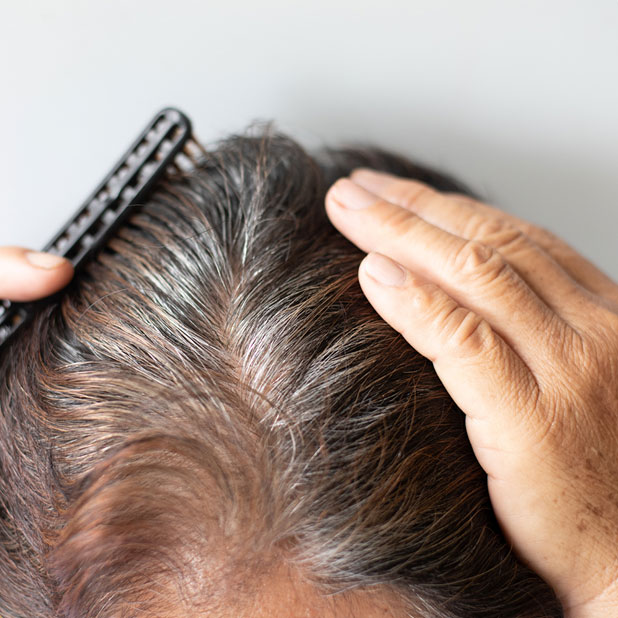
Every plan is medically guided by licensed providers — no symptom-only prescriptions.
Comprehensive panels before any prescription — never a one-size protocol.
Treatment matched to your labs, symptoms, and long-term health goals.

Regrowth that starts at the root.
Most off-the-shelf hair products skip the diagnostic. We don’t. Every plan starts with identifying the cause — hormonal, nutritional, autoimmune, or pattern-related — and matches the treatment to it.
From PRP injections to cold laser therapy to FUE transplant for advanced cases, we offer the full spectrum of evidence-based hair-restoration options. Standardized photos and regular progress reviews keep results measurable.
- PRP therapy — growth factors from your own blood
- Cold Laser (LLLT) — in-office or at-home maintenance
- FUE Hair Transplant — for advanced cases
- Diagnostic labs to identify root cause
Thinning, addressed.
Hair loss has many causes. We diagnose first, then treat — with the right therapy for your pattern.
Male-pattern hair loss
Female-pattern thinning
Hormone-related shedding
Postpartum hair loss
Receding hairline
Crown thinning
Diffuse thinning
Patchy thinning
A clear path, guided start to finish.
Consult
Medical Provider intake covering goals, symptoms, history, and lifestyle.
Labs
Comprehensive hormone, metabolic, and inflammatory panels.
Protocol
Personalized plan matched to your labs — not a formulary default.
Treat
Care begins in-clinic or via telehealth, with discreet shipping where needed.
Sustain
Ongoing labs, dose refinement, and long-term support.
Three approaches, matched to your stage of hair loss.
Treatment selection depends on your hair loss pattern and stage. Many patients combine modalities for compounding results.
PRP Therapy
Your Body's Growth Factors.Platelet-Rich Plasma uses a concentrated sample of your own blood platelets, which are injected into the scalp to stimulate hair follicle activity, improve circulation, and promote natural hair regrowth.
- Best for early-to-moderate loss
- Stimulates dormant follicles
- Improves scalp circulation
Cold Laser Therapy (LLLT)
Light. Awakens. Follicles.A painless, non-invasive treatment using red light energy on dormant follicles. Performed in-office or at home using FDA-cleared laser cap technology — great for patients who prefer medication-free options.
- FDA-cleared technology
- At-home or in-clinic option
- Painless, no downtime
FUE Hair Transplant
Permanent. Precise.Follicular Unit Extraction surgically relocates individual follicles for a permanent solution to advanced hair loss. Natural-looking results, no linear scarring, minimal recovery time.
- Permanent solution
- No linear scarring
- Natural-looking results
Natural results, addressed at the root.
VidaVital’s approach emphasizes natural-looking results and scalp health optimization — not just covering thinning, but addressing what’s driving it. Most treatments require little to no downtime.
You can expect:
- Natural-looking regrowth
- Improved scalp health
- Custom plans by hair-loss pattern
- Little-to-no downtime for most treatments
- Root-cause workup, not symptom-only care
The VidaVital difference.
Hair loss is rarely just genetics. VidaVital looks at hormones, nutrition, and underlying medical causes before recommending a treatment.
We examine hormonal imbalances, nutrition, and genetics — not just the visible thinning.
Our team maintains current knowledge of effective and safe protocols across all three hair-restoration modalities.
From PRP to precision-based transplants, we use the latest technology for optimal outcomes.
Transparent communication throughout the treatment journey — honest expectations, no overselling.
Good to know.
The questions we hear most about hair restoration.
How does PRP hair restoration work?
How long does hair restoration treatment take to show results?
Is hair restoration treatment suitable for both men and women?
What is the difference between PRP, laser therapy, and FUE hair transplant?
Start your regrowth plan.
Don’t wait until the thinning is advanced. The earlier we diagnose, the more options you have.